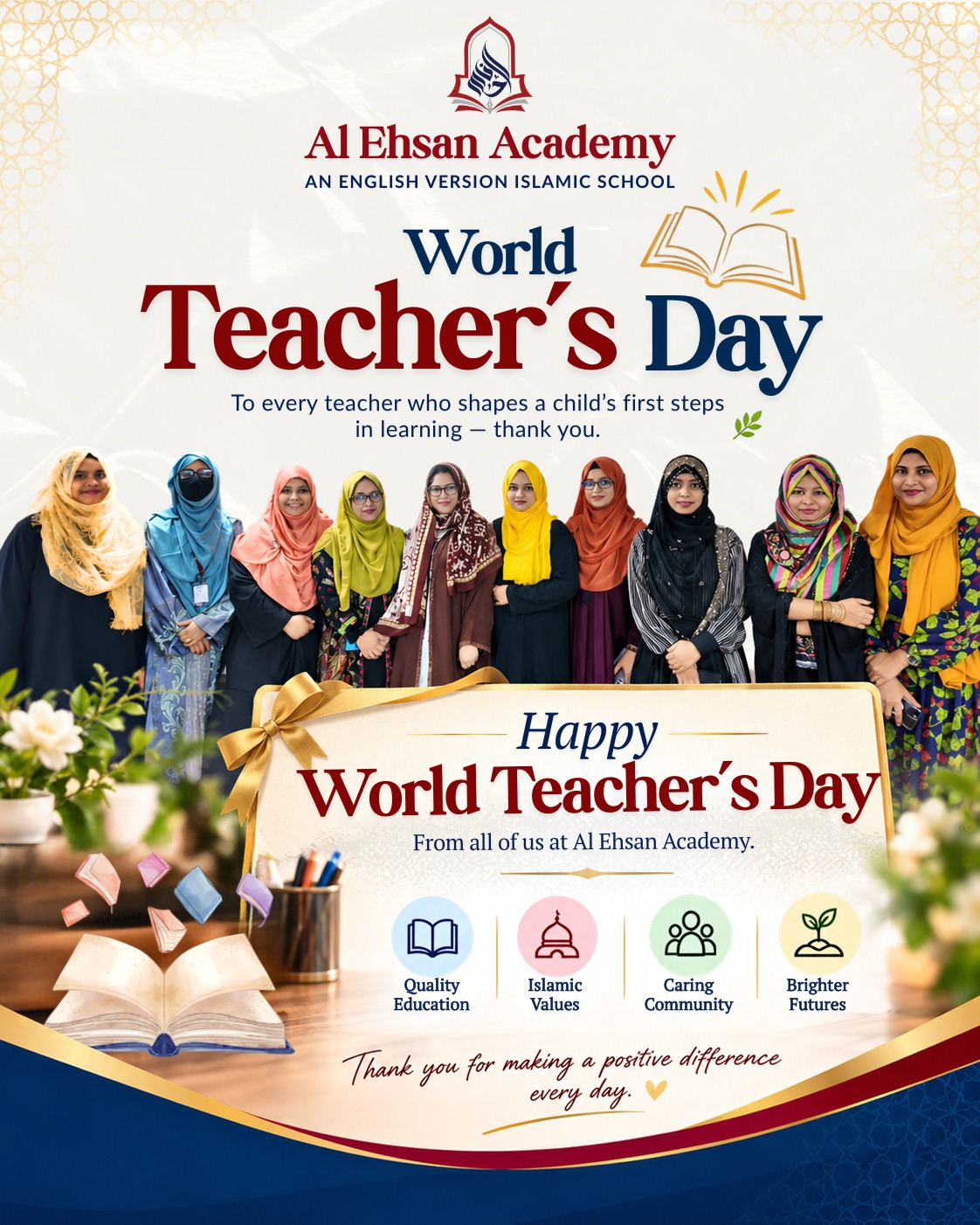
On World Teachers’ Day, schools are encouraged not only to celebrate teachers but also to reflect on how teaching quality can be strengthened for the benefit of every child. An important question is: how do we honour teachers in a way that improves children’s everyday experience of learning?
Bangladesh’s current policy direction makes this particularly relevant. NCTB has published 2026 teacher guides for pre-primary children aged 4+ and 5+ and for Classes 1, 2 and 3, alongside the Primary-Level Assessment Guideline 2026. The distinction between age groups matters. A young child should not simply receive a shorter version of a Class 3 lesson.
Current Bangladesh education research also highlights continuing foundational-learning challenges and the importance of teaching quality, teacher development, equity and supportive leadership. The practical implication is straightforward: curriculum reform reaches children only when teachers have time, training, classroom-ready tools and appropriate professional support.
Five classroom practices deserve particular attention.
1. Create a supportive classroom culture before demanding performance.
Children should know what is expected, but correction should preserve dignity. Teachers can model calm speech, honesty, listening, turn-taking, responsibility and respect. In an Islamic setting, this is one of the most natural ways adab becomes lived behaviour rather than vocabulary to memorise.
2. Make the learning purpose clear and explain it well.
A busy classroom is not necessarily a learning classroom. A sorting activity might develop comparison and mathematical language. A picture-book discussion might target vocabulary and comprehension. A Qur’an lesson might focus specifically on accurate recognition or recitation. One clear learning intention usually produces a stronger lesson than several loosely connected intentions.
3. Talk less at children and create more purposeful conversation.
Strong oral-language teaching uses purposeful dialogue, stories, vocabulary, structured questioning and modelling. Teachers can move beyond “Do you understand?” towards questions such as “How do you know?”, “What happened first?”, “Can you explain it another way?” and “Why did you choose that group?”
4. Use activities to generate thinking, not simply excitement.
Young children benefit from stories, movement, manipulatives, role play, pictures and hands-on investigation. But activity-based learning becomes superficial when the activity itself becomes the objective.
A useful sequence is:
Question → child action → child explanation → teacher next step.
The teacher observes, prompts, scaffolds and gradually transfers responsibility to the learner.
5. Check learning, give useful feedback and develop independence.
Assessment should answer one practical question: What does this child need next?
For younger children, useful assessment often happens during teaching. The teacher hears a child read, listens to an explanation, watches how a child groups objects, notices whether vocabulary is used independently or identifies where Qur’anic decoding breaks down.
Feedback should be specific enough to help. Instead of simply saying “Wrong”, a teacher might say: “You recognised the first sound correctly. Look at the next one again.”
High-quality education also develops autonomy, perseverance, collaboration and social development. These qualities can reinforce communication, confidence and adab.
Honouring teachers also means improving how teachers themselves learn.
Professional development should be a cycle rather than a one-off workshop:
identify one practice → model it → rehearse it → observe a short lesson sample → give specific feedback → agree one action → revisit it.
This should be developmental rather than punitive. Observation should not primarily be used to rank or embarrass teachers.
International Islamic education systems provide useful examples, but not ready-made templates for Dhaka. MUIS in Singapore, Safar in the UK, Qatar’s Khebrat programme, CISNA in North America and Brunei’s teacher-development structures all illustrate different forms of professional learning, observation, support or continuous development. AEA should not import these systems unchanged. Bangladesh regulations, NCTB expectations, school resources, teacher workload, language realities and scholarly review of Islamic content must come first.
For Khilkhet and Dhaka, schools should also avoid assuming that every child arrives with the same English exposure, number of books, parental time, tutoring or learning resources. High-quality teaching gives different children access to ambitious learning through appropriate explanation, interaction, support and challenge.
This World Teachers’ Day, the strongest way to honour teachers is not simply to say “thank you”. It is to provide clear curriculum expectations, usable planning tools, protected time to improve, purposeful professional learning, respectful feedback and supportive leadership.
Because stronger teachers create stronger classrooms and stronger classrooms give children a better foundation in faith, knowledge, communication, confidence and adab.
About the Author
Prof. Mazibar Rahman Howlader is the Principal of Al Ehsan Academy. He writes and speaks on education, character development, Islamic values, and the role of schools in nurturing future generations.