For today’s young children, screens are part of ordinary life. Phones and tablets can support communication, learning, Qur’an listening and English-language exposure, but they can also displace conversation, stories, movement, sleep and family interaction. The educational challenge is therefore not to reject technology, but to use it with purpose and protect the experiences on which healthy childhood and strong learning depend.
Bangladesh’s early-learning contextBangladesh has made major progress in expanding access to education, yet foundational learning and home learning resources remain important challenges. UNICEF’s Bangladesh data based on the 2025 Multiple Indicator Cluster Survey reports that 72.1% of households have internet access from home, while only 7.6% of children under five have three or more children’s books at home. Among children aged 7–14, 50.2% demonstrate foundational reading skills and 39.2% foundational numeracy skills.
These figures should not be interpreted as evidence that screens cause weak learning outcomes. Instead, they show why schools and families need to protect the experiences on which literacy develops: conversation, books, storytelling, meaningful language, play and focused interaction.
Not all screen time is the sameCurrent child-development guidance increasingly distinguishes between different kinds of digital use. The American Academy of Pediatrics’ 2026 policy on digital ecosystems notes that well-designed media can support learning, while engagement-driven products can encourage prolonged use and crowd out sleep, movement, reading and family interaction.
For children under five, the World Health Organization recommends strong limits on sedentary screen time and specifically encourages reading and storytelling with a caregiver. This suggests a practical rule for early education: digital tools should be purposeful, limited, age-appropriate and, especially for younger children, guided by an adult.
A short teacher-guided phonics activity, a carefully selected Qur’an recitation or an interactive numeracy exercise is fundamentally different from prolonged, unsupervised scrolling or short-form entertainment.
Reading must remain a human activityOne of the most powerful learning experiences available to a young child remains remarkably simple: an adult, a child and a story. Shared reading allows adults to ask questions, explain unfamiliar vocabulary, connect ideas to the child’s experience and notice whether the child actually understands.
Questions such as “What do you think will happen next?”, “Why was the character upset?” and “Can you tell me the story in your own words?” develop vocabulary, comprehension, memory, reasoning and expression. These interactions are inexpensive and adaptable to different household circumstances.
English-version education and the home languageBangladesh’s National Curriculum and Textbook Board continues to publish English-version primary materials, including for Classes 1, 2 and 3. But English-version education should not require families to abandon Bangla at home.
UNESCO’s work on multilingual education emphasises the value of strong learning foundations in a language children understand. Parents can read an English story, explain a difficult concept in Bangla when necessary, ask the child to describe a picture in English, and gradually expand vocabulary. The objective is understanding plus language development, not English performance without comprehension.
Technology, faith and adabHealthy technology use also has a character dimension. Children gradually learn that attention has value: there are times to listen, speak, read, play, pray, engage with family and put a device away. Islamic education becomes meaningful when these values are practised rather than presented only as information.
Yaqeen Institute’s work on Islamic parenting highlights the importance of parental accessibility and responsiveness, including the effect of adults being physically present but repeatedly occupied by phones or computers. Safar Publications likewise presents Islamic learning as connecting knowledge, character and the partnership between home and classroom. Children learn digital manners partly by observing adults.
A practical approach from Pre-Play to Class 3For Pre-Play and the earliest years, real-world interaction should dominate: talking, movement, play, rhymes, stories, sensory activities and warm relationships. Where screens are used, they should be brief, purposeful and adult-guided.
For KG and early literacy, technology can occasionally support phonics, vocabulary, Arabic sounds, Qur’an listening and number concepts, while physical books, handwriting, manipulatives, conversation and active play remain central.
By Classes 1–3, children can gradually develop digital judgement. Adults can ask: “Why are we using this device?”, “Is this helping us learn?”, “Can we check whether this information is reliable?” and “Is it time to put the screen away?” These questions begin to build digital literacy and self-discipline.
A realistic approach for families in Khilkhet and DhakaFamilies in Khilkhet and the wider Dhaka community do not all have the same schedules, incomes, educational backgrounds, language exposure or access to learning materials. Good home-learning advice should therefore avoid assuming that every family owns tablets, subscriptions, extensive book collections or expensive educational resources.
Low-cost practices can be highly valuable: telling a story, borrowing or sharing books, discussing pictures, making word cards from paper, counting household objects, identifying shapes around the home, or asking a child to explain what they learned that day. The quality of interaction matters more than the price of the resource.
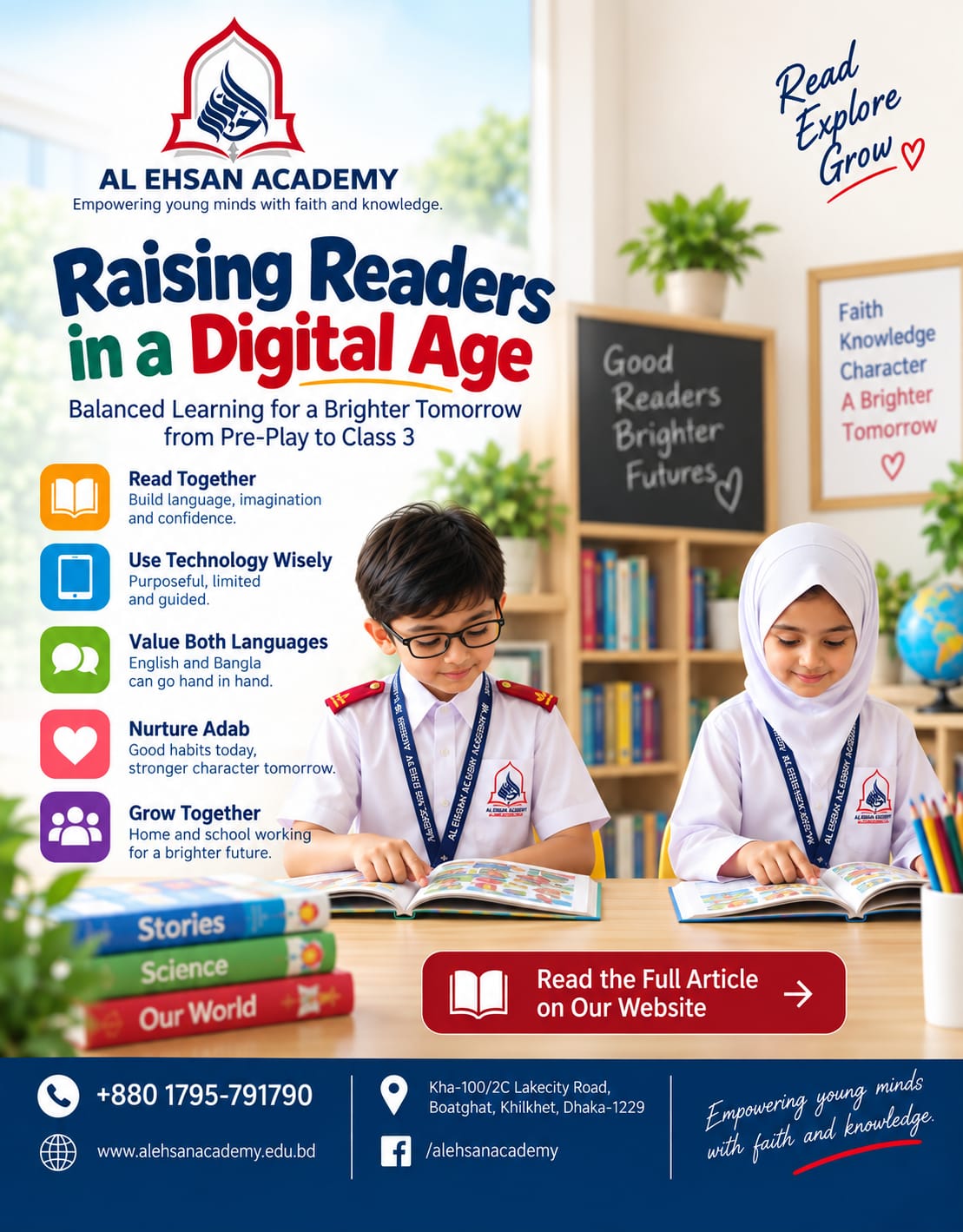
Five habits families can start todayHabit
What it looks like at home
Read together every day
Even 10–15 focused minutes of reading or storytelling can create valuable language interaction.
Use technology with a purpose
Decide what the child is using the device for and what learning or communication it supports.
Value both English and Bangla
Build English confidently while using the child’s strongest language to support understanding when needed.
Model digital adab
Let children see adults put devices away during conversation, meals, prayer, reading and family time.
Talk about learning
Ask children to explain, predict, retell and question rather than only repeat answers.
Children growing up today will need technological competence. Avoiding all technology is neither realistic nor necessarily desirable. The goal is to develop digital confidence alongside the ability to read carefully, think independently, communicate respectfully, control attention and know when to disconnect.
For Al Ehsan Academy’s Pre-Play-to-Class-3 context, this offers a clear educational direction: use technology deliberately, protect reading and conversation, involve parents realistically, and help children grow in both knowledge and character. In that sense, literacy, responsible technology use and adab are not separate goals; together they help empower young minds with faith and knowledge.